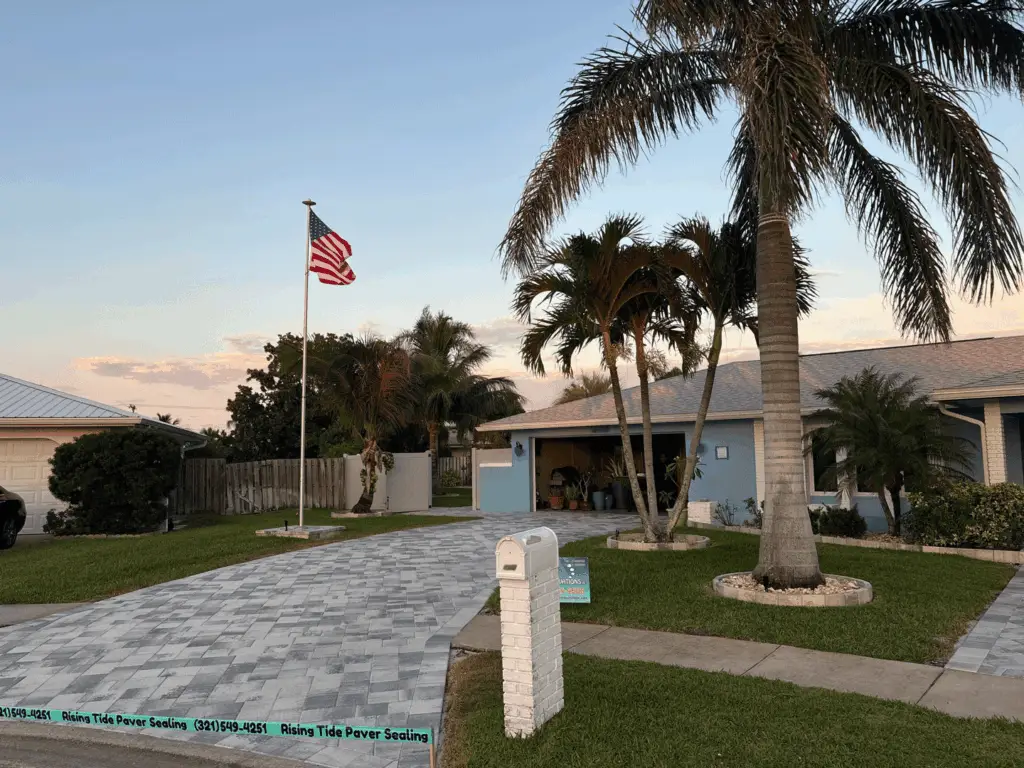
Most paver sealing problems in Florida come back to moisture and application: sealer that went down over damp pavers or wet joint sand, sealer applied too thick, or sealer applied over efflorescence. The problems we run into most around Brevard County are a cloudy white finish, peeling or flaking, a slippery surface, and efflorescence. A sealer coat that has truly failed usually has to come off before the pavers can be sealed again.
Why Florida Is Hard on Sealer
Sealer and water do not mix during application. When the National Weather Service office in Melbourne studied 22 years of data from a north Melbourne rain gauge, 64 percent of the rain fell during the wet season, which ran about four and a half months. Add sprinklers, groundwater, poor drainage and morning dew, and pavers spend a lot of time damp.
The Interlocking Concrete Pavement Institute (ICPI) says cleaned pavers must be completely dry before most sealers go on, with at least 24 hours without moisture or surface dampness. In a wet summer, that window is easy to miss, and most of the problems below start right there.
Problem 1: Cloudy or White Sealer (Blushing)
What it looks like: a milky, white or hazy finish, sometimes in patches. It often shows up soon after sealing or after a stretch of rain. In the trade this is often called blushing.
What causes it: ICPI lists the conditions under which a sealer can whiten or pull efflorescence to the surface:
- The surface and joints were not dry when the sealer went on
- The pavers had not had enough exposure to moisture yet
- There is a source of efflorescence under the pavers, in the sand, base or soil
- The sealer is not breathable, so moisture cannot move through it and evaporate
ICPI adds that a sealer can also turn cloudy if the base under the pavers drains poorly, if it was applied to saturated joint sand, or if it was applied too thick. Solvent-based sealers are more prone to this hazy look.
How it gets fixed: ICPI says the clouded sealer must be removed or re-dissolved. With some sealers, re-dissolving the existing coat can clear the haze. When it does not, or the haze runs deep, the fix is paver stripping: remove the old sealer, clean the pavers, let them dry fully, refill the joint sand and seal again.
Problem 2: Peeling, Flaking or Bubbling
What it looks like: sealer lifting off in flakes or sheets, or small bubbles and blisters in the coat. This is delamination, the separation of layers between the pavers and the sealer.
What causes it: mainly improper application and moisture trapped under the sealer. Sealing over dirt, efflorescence or leftover residue from an old sealer gives the new coat nothing solid to grip. Improper stripping that leaves residue behind keeps new sealer from bonding.
How it gets fixed: another coat on top does not solve it. The peeling sealer has to come off so the new sealer can bond to the pavers themselves. ICPI also notes that some sealer types cannot be rejuvenated by recoating at all, and their removal is best left to professionals. Stripping takes specialized strippers and controlled pressure cleaning; too much pressure can wash out joint sand and even crack pavers.
Problem 3: A Slippery Finish
What it looks like: pavers that feel slick underfoot, especially when wet.
What causes it: usually too much sealer. ICPI says adequate slip resistance should be maintained with properly applied sealers and warns against over-applying sealer so that the surface becomes slippery when cured. Old sealer that has degraded can also turn slick, which is a common complaint on pool decks. And on shaded pavers, a film of algae or mildew can be the real culprit.
How it gets fixed: if it is growth, a proper cleaning takes care of it. If it is a heavy or degraded sealer, the excess or the old coat generally has to be removed, then a properly applied coat goes back on with slip resistance in mind. We cover pool areas specifically in our guide to pool deck paver sealing.
Problem 4: Efflorescence
What it looks like: a white, powdery haze, most noticeable on dark pavers. It disappears when the pavers are wet and comes back as they dry.
What causes it: efflorescence is not a sealer failure. Water moving through concrete pavers carries calcium hydroxide to the surface, where it reacts with carbon dioxide and dries as white calcium carbonate. ICPI says it does not affect the structural performance or durability of the pavers, and that it typically stops developing in about 18 to 24 months.
How it gets fixed: on unsealed pavers, it can be cleaned off with a cleaner made for concrete pavers, though it may come back while the reaction is still going. The real problem is sealing over it. ICPI says efflorescence must be removed and the pavers completely dry before sealing, or the sealer can lock it in and whiten. Our post on efflorescence on pavers covers it in detail.
Two More Problems Worth Knowing
- Patchy or uneven coverage. Areas where the sealer has worn differently, or where it went on unevenly. ICPI notes that a clogged spray nozzle can drop large droplets that give a poor appearance.
- Trapped stains. Dirt or stains sealed beneath the surface during an improper application. The sealer has to come off to reach them.
How We Approach a Failed Sealer
Every repair starts with figuring out what actually went wrong, because cloudy sealer, efflorescence and peeling can look alike from the driveway. Once we know, the basic process for a failed coat is the same: strip the old sealer, clean the pavers, re-sand the joints and apply new sealer. We take the time to remove the old sealer completely, because leftover residue is what keeps the next coat from lasting.
If you are weighing a do-it-yourself fix, our comparison of DIY vs professional paver sealing is worth a read first.
Rising Tide Paver Sealing is a veteran-owned company based in Palm Bay, serving Brevard County from Titusville down to Palm Bay and the beaches. If your sealed pavers are cloudy, peeling or slick, call (321) 549-4251 or request a free estimate and we will take a look.
Frequently Asked Questions
Why did my paver sealer turn white or cloudy?
Usually moisture. ICPI lists sealing before the pavers and joints are fully dry, a source of efflorescence under the pavers, and a sealer that does not let moisture escape, along with poor drainage under the pavers, sealer applied over saturated joint sand, or a coat applied too thick. A clouded sealer generally has to be removed or re-dissolved.
Can you fix cloudy paver sealer without stripping it?
Sometimes. ICPI says a whitened sealer must be removed or re-dissolved, and with some sealers, re-dissolving the coat can clear the haze. When that does not work, or the sealer is also peeling, stripping it and sealing again is the usual fix.
Why is my paver sealer peeling?
Peeling, flaking and bubbles are signs of delamination, where the sealer separates from the pavers. It usually traces back to moisture trapped under the sealer or an improper application, such as sealing over dirt or leftover sealer residue. The failing coat has to come off before new sealer will bond.
Why are my sealed pavers slippery?
Most often there is too much sealer on the surface. ICPI warns that over-applying sealer can leave the surface slippery once it cures, and worn-out sealer can also turn slick, especially on pool decks. Algae or mildew growing on a shaded surface can make it slippery too.
Is it efflorescence or a sealer problem?
Wet the area. Efflorescence disappears while the pavers are wet and comes back as they dry, and it is the classic white haze on new or never-sealed pavers. A white haze on pavers that were already sealed, especially with peeling or bubbling, more likely points to the sealer.
Sources
- Interlocking Concrete Pavement Institute (ICPI): Tech Spec 5, Cleaning, Sealing and Joint Sand Stabilization of Interlocking Concrete Pavement
- Interlocking Concrete Pavement Institute (ICPI): Managing Efflorescence on Concrete Pavers, A Guide for Consumers
- National Weather Service Melbourne: Wet season rainfall statistics, north Melbourne station