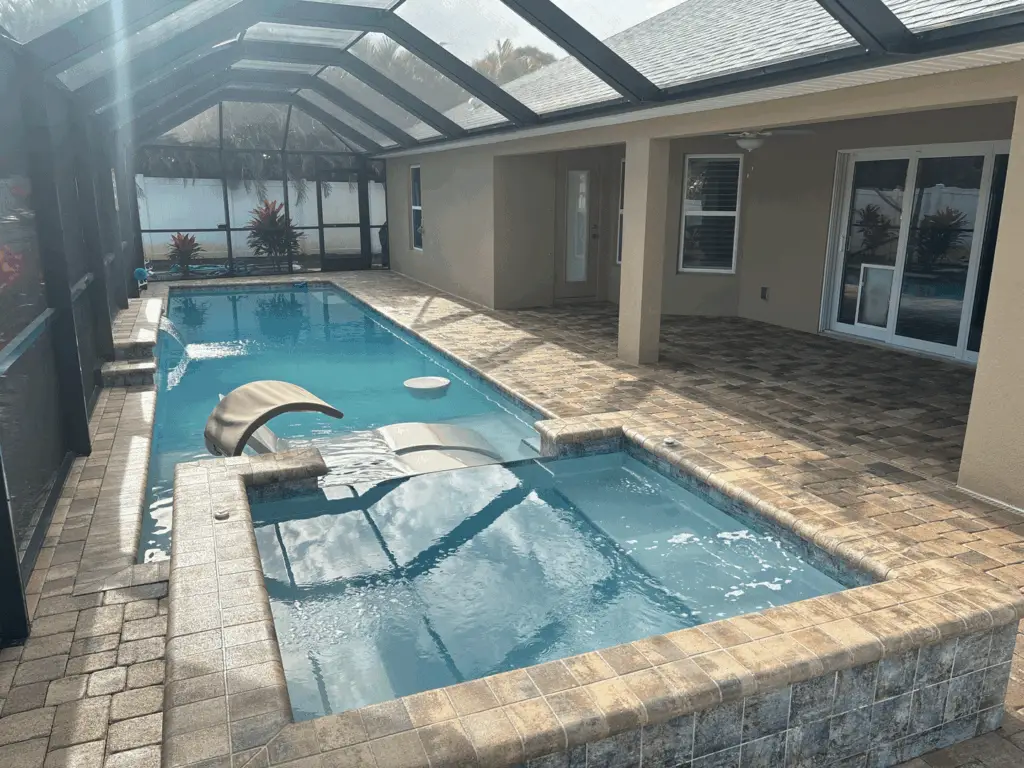
Pool deck paver sealing protects the hardest-working pavers on your property from chlorine, salt, sunscreen and constant water. Sealed pool deck pavers resist stains, hold their color longer in the sun, and are easier to keep clean. The catch: a pool deck needs a sealer suited to wet, chemically treated areas, applied so the surface does not turn slippery or cloudy.
Why Pool Decks Are Harder on Pavers
A driveway deals with oil and tire marks. A pool deck gets wet every day, often with treated water, and then bakes in full sun. Pool deck pavers are constantly exposed to water, the chemicals used to treat the pool, and things like suntan lotion. Here is what they are up against:
- Chlorinated splash-out that dries on the surface over and over
- Salt, if you run a saltwater system
- Sunscreen, drinks and food that leave greasy or sugary stains
- Standing water and shade, which invite mold, mildew and algae
- Bare feet, furniture and pool toys moving across the same spots every day
The weather adds to it. The National Weather Service office in Melbourne puts the median start of our wet season at May 28 and the start of the dry season at October 17. Those are also the busiest months for most backyard pools, so the deck gets rain, splash and sun all at once.
Chlorine and Salt Water
Sealing works by limiting how much water, and whatever is dissolved in it, soaks into the pavers. The Interlocking Concrete Pavement Institute (ICPI) notes that penetrating sealers made from silanes and siloxanes reduce the intrusion of chloride and are useful around pool decks to minimize degradation from chlorine.
Saltwater pools bring their own wear. Paver maker Techo-Bloc points out that salt water, while gentler on skin and eyes, can be tough on materials and can cause pitting, scaling and discoloration on standard pavers. It calls sealing a saltwater pool deck a smart choice and recommends regular cleaning to manage salt residue.
A few habits help between sealings:
- Rinse the deck with fresh water from the hose now and then, especially along the coping and steps where splash dries in place.
- Handle and store pool chemicals away from the pavers. A spill of concentrated product is far harsher than splash-out.
- Clean up sunscreen and drink spills before they bake in.
Which sealer is right for your deck depends on your pavers, your pool system and the look you want. We go over those choices during the estimate for paver sealing.
Keeping a Sealed Pool Deck From Getting Slippery
Slip resistance is the first thing to get right around a pool. Pool deck sealing calls for special attention to slip resistance as well as chlorine exposure. ICPI says adequate slip resistance should be maintained with properly applied sealers, and warns installers not to over-apply sealer so that the surface becomes slippery when cured.
In practice, a slick pool deck usually comes from one of two things. The first is too much sealer: a thick build-up sitting on top of the pavers. The second is old sealer that has broken down. Slippery surfaces from degraded sealer on pool decks are one of the failure symptoms that call for paver stripping, because the old coat has to come off before new sealer goes on.
Some sealers can also be mixed with an anti-slip additive for extra traction. If traction is a concern for your family, ask about it at the estimate so the sealer and finish are chosen with that in mind.
Heat and Full Sun
Pool decks rarely get shade, and that affects both the sealer and your feet. ICPI notes that the curing time of water-based sealers varies with temperature, wind and humidity, which is one reason application timing matters on a hot, open deck.
As for hot feet, paver color does more than sealer. The EPA describes cool pavements as materials that reflect more solar energy and stay cooler than conventional pavements. In an Arizona pilot study the EPA cites, conventional asphalt reached surface temperatures up to 152°F at midday, while cool pavements stayed 10 to 16°F cooler. That study was about asphalt, not pool pavers, but it shows how much a surface’s reflectivity matters. Sealer protects your paver color; it is not a cooling product.
The sun also fades pavers. Sealing guards against the UV exposure that dulls color, and a fresh coat brings out the natural color of the pavers again.
Do Not Forget the Coping
The coping, the cap around the edge of the pool, takes the most splash. Sealing paver coping along with the deck helps repel stains and brings out its color, and it is one of the most satisfying parts of sealing a pool deck. Loose or uneven coping and sunken deck pavers should be fixed before anything gets sealed. That kind of repair is part of our paver restoration work.
New Pool Deck? Give It Time
Brand-new pavers are not ready for sealer on day one. Techo-Bloc recommends waiting 60 days after installation so the pavers can cure before a deep clean and professional sealing. New pavers can also show a white haze called efflorescence, which ICPI says has to be removed, with the pavers completely dry, before sealing. Our post on efflorescence on pavers explains what it is and why it matters.
Caring for a Sealed Pool Deck
- Sweep often and rinse with a garden hose to keep salt, sand and leaves from sitting on the surface.
- Watch shady corners and low spots where water stands. That is where mold and mildew start.
- If you pressure wash, keep it gentle. Our guide to pressure washing sealed pavers covers how to clean without stripping the sealer or the joint sand.
- Plan to reseal every 2 to 3 years. Pool chemicals and full sun can push a deck toward the shorter end of that window.
Rising Tide Paver Sealing is a veteran-owned company based in Palm Bay, sealing pool decks and coping across Brevard County, from Titusville down to Palm Bay and the beaches. Call (321) 549-4251 or request a free estimate and we will take a look at your pool deck.
Frequently Asked Questions
Should you seal pool deck pavers?
For most concrete paver pool decks, yes. Sealing helps the pavers resist stains from pool chemicals, sunscreen and drinks, slows fading from the sun, and makes the deck easier to clean. The sealer needs to suit a wet, chemically treated area and be applied so the surface does not get slippery.
Does sealing make pool deck pavers slippery?
It can if the sealer goes on too heavy. ICPI warns against over-applying sealer so that the surface becomes slippery once it cures, and worn-out old sealer can also turn slick. A properly applied coat, chosen with slip resistance in mind, is how you avoid it.
Can you seal pavers around a saltwater pool?
Yes, and it is a good idea. Paver maker Techo-Bloc notes that salt can cause pitting, scaling and discoloration on standard pavers and calls sealing a smart choice around saltwater pools. Rinsing salt residue off the deck with fresh water between sealings also helps.
How often should pool deck pavers be resealed?
For most Brevard County pool decks, every 2 to 3 years. Constant water, pool chemicals and full sun all wear on sealer, so a busy deck tends to need it toward the shorter end of that window.
How long after installation can new pool deck pavers be sealed?
Techo-Bloc recommends waiting 60 days after installation so the pavers can cure before a deep clean and professional sealing. Any efflorescence also has to be cleaned off, and the pavers have to be completely dry, before sealer goes on.
Sources
- Interlocking Concrete Pavement Institute (ICPI): Tech Spec 5, Cleaning, Sealing and Joint Sand Stabilization of Interlocking Concrete Pavement
- Techo-Bloc: Are Concrete Pavers Safe Around Salt Water Pools
- U.S. EPA: Using Cool Pavements to Reduce Heat Islands
- National Weather Service Melbourne: Wet/Dry Season Onset