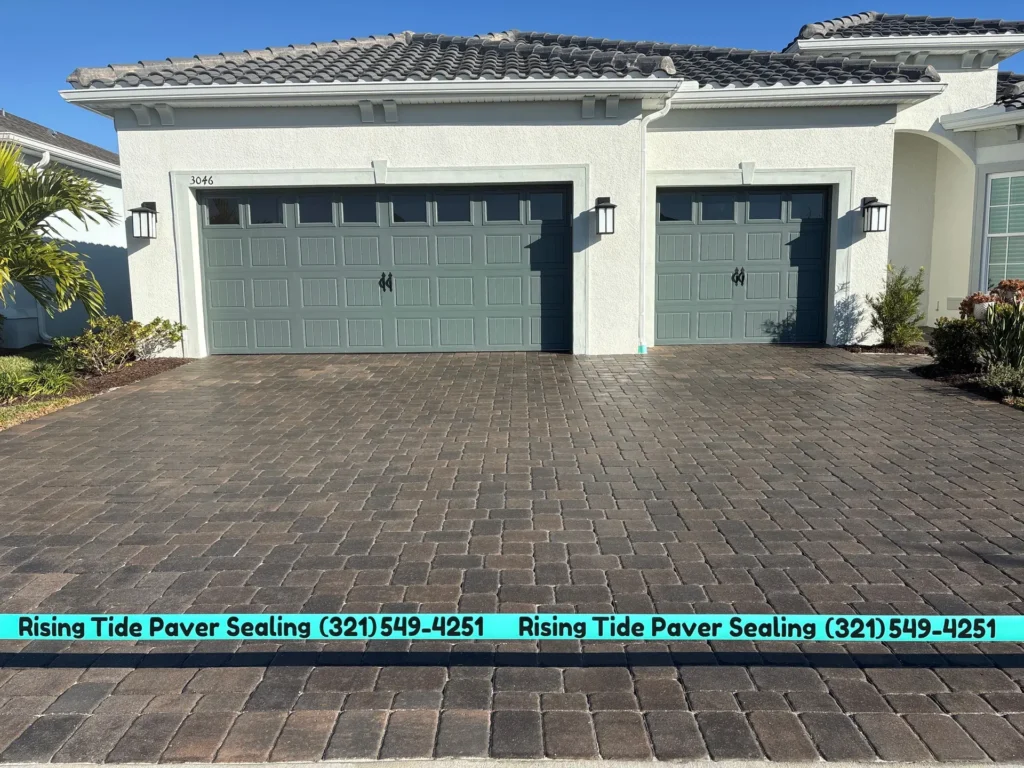
You rinse the driveway and it looks great while it is wet. Then it dries, and a chalky white film comes right back. That film is most likely efflorescence. The good news: it is a cosmetic issue, not damage. The part that matters is timing. Efflorescence has to be gone before anyone seals your pavers, or the sealer can lock it in.
What Efflorescence on Pavers Actually Is
Concrete pavers are made with cement, and cement produces lime. The pavers look solid, but they are full of tiny capillaries that run from the inside to the surface. When water gets into those capillaries, the lime forms calcium hydroxide, which travels to the surface. There it reacts with carbon dioxide in the air and leaves behind calcium carbonate: the white haze you are looking at.
The lime does not always come from the pavers themselves. The Interlocking Concrete Pavement Institute (ICPI) notes it can also come from the bedding sand, the base underneath, or the soil.
Two quick tells: it shows up more on dark pavers, and it disappears when the pavers are wet, then returns as they dry. If you hose down a hazy spot and it vanishes, efflorescence is the likely answer.
Is It Hurting Your Pavers?
No. ICPI says efflorescence does not affect the structural performance or durability of concrete pavers, and a paver manufacturer’s maintenance guide calls it an aesthetic concern, not a structural one. Your pavers are not fading, even though the haze makes them look washed out. That is especially frustrating on a new driveway, but it is not a sign of a defective product.
Why Brevard County Pavers See It
Water is the delivery truck. Rain, sprinkler systems, groundwater, poor drainage and even morning dew all push moisture into pavers, and the moisture carries the calcium hydroxide up with it.
Around here we get a lot of that water in a short window. When the National Weather Service in Melbourne studied 22 years of data from a north Melbourne rain gauge, 64 percent of the rain fell during the wet season, which ran about four and a half months. Add irrigation running on a schedule, and pavers on the Space Coast get plenty of chances to move water through.
Timing matters too. ICPI says efflorescence can show up right away or within months of installation, and can peak as soon as 60 days in. If your pavers went in during a dry stretch, the haze may not appear until the next round of wet weather.
Will It Go Away on Its Own?
Yes, eventually. Efflorescence stops when there is no more calcium hydroxide left to move to the surface, and rainwater wears the deposits away over time. ICPI says it typically stops developing in about 18 to 24 months, and that it can come and go faster in places with frequent rain and sunny days.
If you do not want to wait, it can be cleaned off with cleaners made for concrete pavers. It may come back while the reaction is still running, so cleaning can take more than one round. If you try it yourself, ICPI and the paver makers are clear on a few points:
- Most efflorescence cleaners contain acid and detergents. Follow the label exactly.
- Test a small spot you cannot easily see before doing the whole area. Strong acids can change the paver color slightly.
- Wear gloves, goggles and protective clothing.
- Keep the runoff off your grass and plants, and do not let cleaner pond in low spots.
- Skip steel-bristle brushes. Loose bristles rust and leave stains. Brass or plastic bristles are fine.
The Big One: Do Not Seal Over It
This is where efflorescence turns from a nuisance into a real problem. ICPI says all dirt, oil stains and efflorescence must be removed before sealing, and the pavers must be completely dry, with at least 24 hours of no moisture. If they are not, the pavers can pull efflorescence up under the new sealer, or the sealer itself can turn white.
ICPI lists the conditions that cause it: the surface and joints are not dry, the pavers have not had enough exposure to moisture yet, there is a source of efflorescence underneath them, or the sealer does not let moisture escape. A sealer applied over saturated joint sand, over a base that drains poorly, or too thick can also go cloudy. When that happens, the sealer generally has to be removed or re-dissolved before the pavers can be sealed again.
A white haze from moisture trapped under a failed sealer is one of the symptoms we see around Brevard County that calls for paver stripping: the old sealer comes off before the pavers can be sealed properly. We cover other failure patterns in common paver sealing problems in Florida.
Efflorescence or Failed Sealer? How to Tell
- The water test. Wet the area. Efflorescence disappears while the pavers are wet and comes back as they dry.
- New or never-sealed pavers with a powdery white film are the classic efflorescence case.
- Pavers that were sealed and now show a white haze, peeling or flaking may have a sealer problem instead, often from moisture trapped under the sealer.
If you are not sure which one you have, that is a normal question. It is part of the assessment we do at the start of every restoration job.
How We Handle It
Efflorescence removal is part of the deep-cleaning step in our paver restoration process, along with dirt, organic growth, oil and rust stains, and old failed sealer. Joint sand and sealing only come after the surface is clean. We look at any white haze before we seal, because sealing over it is the mistake that is hardest to undo.
If your pavers have a haze you cannot shake, give us a call at (321) 549-4251 or request a free estimate. We serve all of Brevard County, from Titusville down to Palm Bay.
Frequently Asked Questions
What causes white haze on pavers?
Usually efflorescence. Concrete pavers contain cement, and when water moves through them it carries calcium hydroxide to the surface. That reacts with carbon dioxide in the air and dries as a white film of calcium carbonate. On pavers that have been sealed, a white haze can also be a sealer problem, so it is worth checking which one you have before anything gets cleaned or resealed.
Does efflorescence damage pavers?
No. The Interlocking Concrete Pavement Institute says efflorescence does not affect the structural performance or durability of concrete pavers. It is a cosmetic issue, and the color underneath has not actually faded.
How long does efflorescence last on pavers?
It stops once the pavers run out of calcium hydroxide to bring to the surface. ICPI says it typically stops developing in about 18 to 24 months, and it can clear faster where rain and sunny days alternate often. Rain also wears it away over time.
Can you seal pavers that have efflorescence?
You should not. ICPI says efflorescence must be removed and the pavers must be completely dry before sealing. Sealing over it can lock the haze in, and a whitened sealer generally has to be removed before the pavers can be resealed.
Does pressure washing remove efflorescence?
A plain rinse can make it look gone while the pavers are wet, but it comes back as they dry, and it can keep returning while the reaction is still going. ICPI describes applying a cleaner made for efflorescence at low pressure, letting it sit, and then rinsing. Too much pressure, or the wrong nozzle angle, can also wash sand out of the joints.
Sources
- Interlocking Concrete Pavement Institute (ICPI): Managing Efflorescence on Concrete Pavers, A Guide for Consumers
- ICPI Tech Spec 5: Cleaning, Sealing and Joint Sand Stabilization of Interlocking Concrete Pavement (revised June 2004)
- Mutual Materials: Maintenance Guidelines for Concrete Paving Products
- National Weather Service Melbourne: Wet season rainfall statistics, north Melbourne station