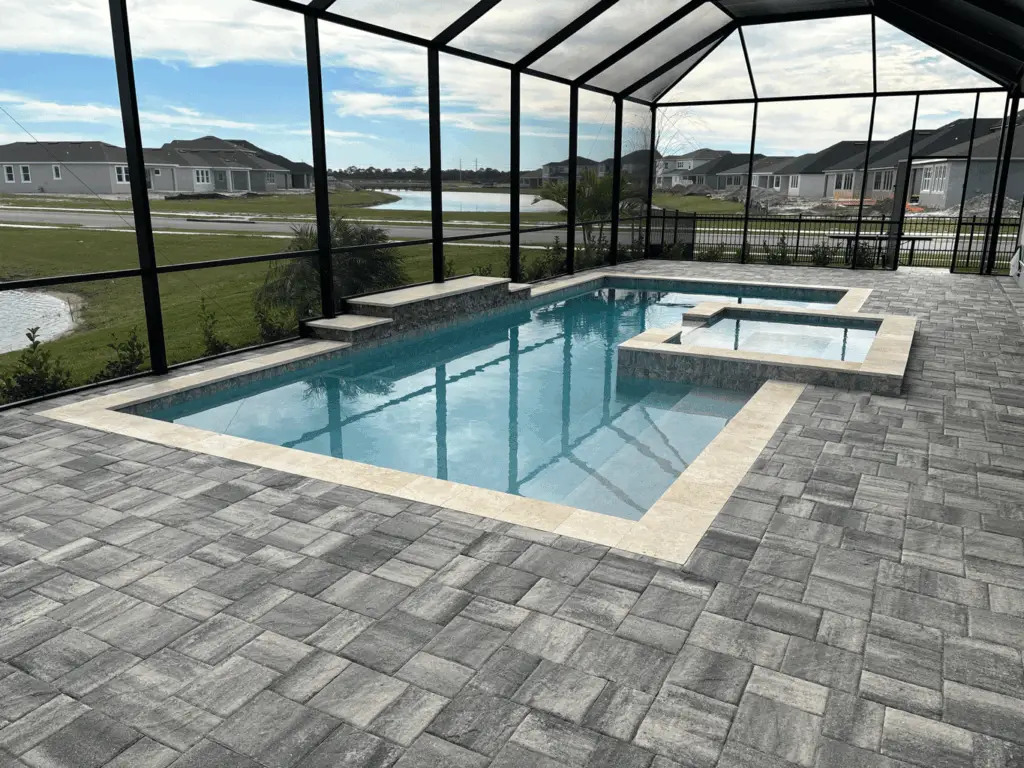
DIY paver sealing can work on a small, clean, never-sealed patio if you have the time and follow the product label exactly. Most problems show up on bigger jobs, or when the prep gets rushed: dirty or damp pavers, sand washed out of the joints, or sealer put on too thick. Those mistakes can leave a cloudy, white finish that has to be stripped off before the pavers can be sealed again.
Here is what each route really involves for a Palm Bay home, so you can make the call with your eyes open.
What a DIY Sealing Job Actually Involves
Rolling on the sealer is the quick part. The Interlocking Concrete Pavement Institute (ICPI) lays out the steps that come first, and most of them are about prep:
- Remove stains, then clean the whole surface, including any white haze (efflorescence). ICPI notes that cleaners with strong acids can change paver color slightly, so test a small hidden spot first and wear goggles and protective clothing.
- Plan for runoff. Keep cleaning solutions off your grass and plants, and turn off sprinklers during cleaning, sealing and drying.
- Refill the joint sand that cleaning washed out, so the joints are full before anything is sealed in.
- Let everything dry. ICPI says to allow at least 24 hours without moisture or surface dampness before most sealers go on.
- Apply the sealer in calm weather. ICPI says a hand roller works for small areas under 1,000 square feet, while bigger areas usually call for a power roller or low-pressure sprayer.
- Keep everyone off it until the sealer is completely dry, typically 24 hours.
In Palm Bay, the drying step is often the hardest one. The National Weather Service office in Melbourne puts the average start of the wet season at May 28 and the start of the dry season at October 17. For much of the year, lining up a full dry day before sealing plus a dry stretch after it means watching the forecast closely.
Where DIY Sealing Goes Wrong
ICPI’s sealing guidance doubles as a list of the most common DIY mistakes:
- Sealing damp pavers or wet joint sand. The sealer can turn white or cloudy, and at that point it has to be removed or re-dissolved.
- Sealing over efflorescence. ICPI says all dirt, oil stains and efflorescence must be removed first, or the haze can end up locked under the sealer.
- Putting on too much. Sealer applied too thick can go cloudy, and ICPI warns that over-applying can leave the surface slippery once it cures. That matters a lot on a pool deck.
- Uneven spraying. A clogged spray nozzle can drop big droplets in spots, which ICPI says hurts both appearance and performance, especially with water-based sealers.
- Blasting out the joint sand while cleaning. ICPI notes a wide spray held at a low angle reduces the risk of dislodging joint sand.
- Using solvent-based sealers in tight spaces. Many solvent-based products are combustible and give off hazardous fumes, and ICPI says never to use them in poorly ventilated or confined areas.
When a sealer fails like this, the fix is usually paver stripping: taking the old coat off so the pavers can be sealed properly. Our post on common paver sealing problems in Florida walks through the usual failure patterns and their fixes.
What a Professional Crew Adds
Mostly it is prep, equipment and experience reading the pavers before anything gets sealed. Our paver sealing service starts with pressure cleaning to remove dirt, mold and organic growth, then repairs to any loose or damaged pavers, then joint sanding to help keep weeds and insects out. Only then does the sealer go on, applied with professional equipment.
There are also choices that are hard to make from a store shelf. We recommend the sealer type, finish and application method for your specific pavers, and you can pick a matte or glossy look. For pavers that have faded badly, a tinted sealer can bring back color that a clear coat cannot.
Cost: DIY vs Professional
DIY material costs vary with the sealer you choose, the size of the area and whatever equipment you buy or rent, so we will not put a number on it here. Professional sealing in Brevard County typically runs $1.85 to $5.00 per square foot, and ours includes the prep: pressure cleaning, repairs and joint sanding. Our paver sealing cost guide breaks down what moves a price up or down.
The real cost to weigh on the DIY side is a coat that fails. Stripping pavers is a messy and costly job, and sealing them properly the first time is the best way to avoid it.
When DIY Makes Sense, and When to Call a Pro
DIY is a reasonable choice when:
- The area is small, like a patio or walkway.
- The pavers have never been sealed, or the old sealer has fully worn away.
- There is no white haze, peeling or flaking on the surface.
- You can count on a dry stretch and are comfortable following the label to the letter.
It is usually worth calling a professional when:
- You are sealing a large driveway or a pool deck.
- There is old sealer on the pavers, especially if it is peeling, hazy or patchy.
- Joints are badly washed out, or pavers are sunken or loose.
- You want a specific finish or need color brought back on faded pavers.
Rising Tide Paver Sealing is a veteran-owned company based right here in Palm Bay, serving all of Brevard County. Whether you end up doing it yourself or not, we are happy to take a look. Call (321) 549-4251 or request a free estimate.
Frequently Asked Questions
Can I seal my pavers myself?
Yes, on a small, clean area with no old sealer on it, if you follow the product label and get the prep right. Bigger jobs, pavers with old or failing sealer, and pool decks are where DIY sealing most often goes wrong.
How long should pavers dry before sealing?
ICPI says the cleaned surface must be completely dry before most sealers are applied, with at least 24 hours without moisture or surface dampness. In Palm Bay’s rainy season, that can take some planning around the forecast.
Why did my pavers turn white after I sealed them?
Usually the pavers or joint sand were still damp, there was efflorescence on or under the surface, or the sealer went on too thick. A cloudy sealer generally has to be removed or re-dissolved before the pavers can be sealed again.
How much does professional paver sealing cost in Palm Bay?
Professional paver sealing in Brevard County typically runs $1.85 to $5.00 per square foot. The price depends on the size of the area, the condition of the pavers and the type of sealer.
How often should pavers be resealed?
For most Brevard County homes, we recommend resealing every 2 to 3 years. Full sun, pool chemicals and heavy traffic push you toward the shorter end.
Sources
- Interlocking Concrete Pavement Institute (ICPI): Tech Spec 5, Cleaning, Sealing and Joint Sand Stabilization of Interlocking Concrete Pavement (revised June 2004)
- Concrete Masonry & Hardscapes Association (formerly ICPI): Tech Note PAV-TEC-006-22, Operation and Maintenance Guide for Interlocking Concrete Pavement
- National Weather Service Melbourne: Wet/Dry Season Onset