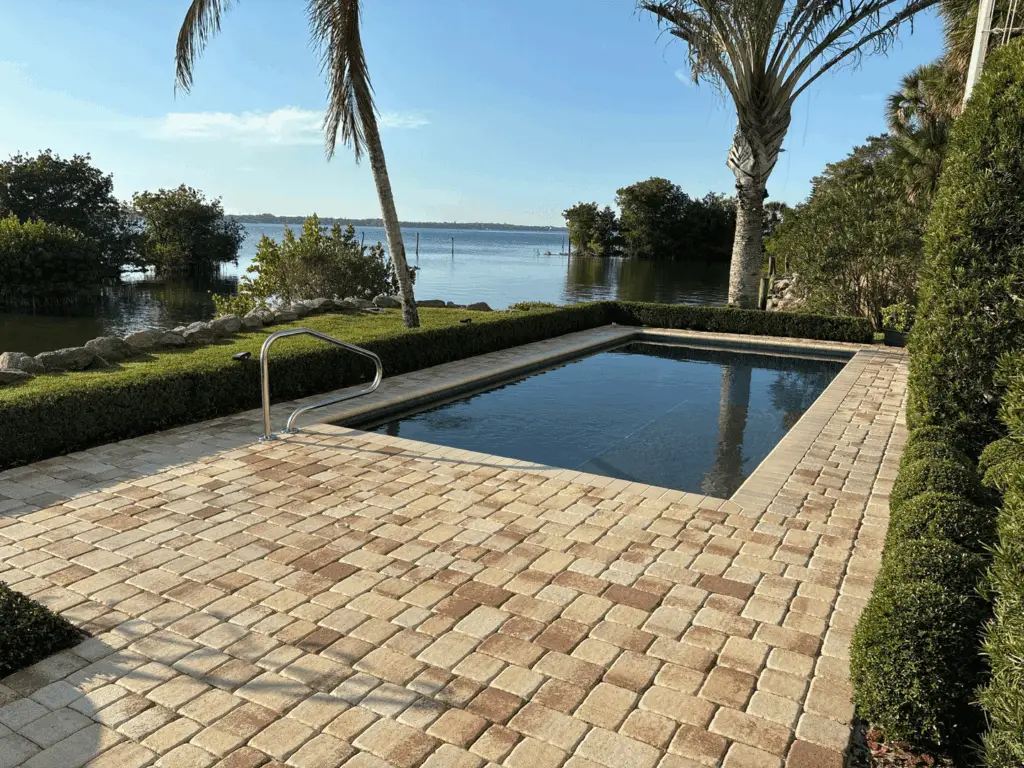
Paver sealing is applying a protective liquid sealer to clean, dry pavers so it soaks in and forms a barrier against water, stains, oil and dirt. Paver sealing in Brevard County does three main jobs: it helps pavers resist stains, it slows the faded, worn look that sun and weather leave behind, and it helps hold the joint sand in place through a long, heavy rainy season. A professional job is mostly preparation. Cleaning, repairs and fresh joint sand all come before any sealer goes on.
If you only need the quick definition, our short explainer on what paver sealing is covers the basics. This guide is the Brevard County version: what our climate does to pavers, what sealing gets you, how a professional job runs, and what it costs.
Paver Sealing, Defined
The Interlocking Concrete Pavement Institute (ICPI) describes sealers as an added layer of protection that reduces the intrusion of water, stains, oils and dirt into the paver surface. The sealer goes over the whole surface, not just the stained spots. ICPI also notes that most sealers darken the pavers and enhance their color. Some add a glossy “wet look,” and others give a low sheen or a flat, natural finish.
Sealer has a second job that people rarely think about. As the liquid goes on, some of it soaks into the sand between the pavers, which helps hold that sand in place. That matters because joint sand is part of what locks the pavers together. ICPI’s maintenance guidance describes it as a key part of the interlock and stiffness of the whole surface.
What Brevard County’s Climate Does to Pavers
Heavy rain in a short window
When the National Weather Service in Melbourne looked at 22 years of data from a north Melbourne rain gauge (1992 to 2013), 64 percent of the rain fell in 38 percent of the year: the wet season, which averaged about 138 days. The same study counted an average of 10 days per year with 1 to 2 inches of rain and 4 days with more than 2 inches.
That much water moving across a driveway takes a toll on the joints. ICPI lists runoff, driving winds and aggressive cleaning among the causes of joint sand loss. Once the sand drops, pavers can loosen and weeds get a foothold.
Sun and weathering
Concrete pavers get their color from pigment held in place by cement. ICPI explains that normal wear from traffic and weather slowly erodes that surface layer, exposing more of the sand and stone underneath and changing the color over time. Cleaning and sealing can slow that change. Our long stretches of strong sun are a big part of the weathering pavers see here.
Salt air and pool chemicals
Homes near the beaches and the Indian River get salt air, and pool decks deal with chlorine every day. ICPI notes that silane and siloxane penetrating sealers help protect pavers exposed to salt air and are useful around pool decks to limit damage from chlorine. Pool decks also need attention to slip resistance, which shapes the choice of sealer and finish.
The Benefits of Sealing Your Pavers
- Stain resistance. ICPI points to driveways and anywhere oil drips are a concern as good candidates for sealing, because sealer helps keep stains from soaking in.
- Richer color. Sealer brings out the paver color, in a matte or glossy finish depending on the look you want.
- Joints that stay full. Sealer worked into the joint sand helps keep it from washing or blowing out.
- Fewer weeds and ants. ICPI notes sealers can help keep seeds from sprouting in the joints and keep ants from moving in. Most weeds there come from windblown seeds, not from underneath.
- Easier upkeep. Dirt has a harder time lodging in a sealed surface, so routine cleaning goes faster.
What sealing will not do is fix structural problems. Sunken areas, cracked pavers and missing sand need to be repaired first, and sealer is the last step, not the first.
How a Professional Paver Sealing Job Runs
Our paver sealing service follows the same order every time, because each step depends on the one before it.
1. Pressure cleaning
Dirt, mold and organic growth come off first. ICPI’s guidance notes that a wide spray pattern held at a low angle reduces the risk of blasting sand out of the joints, which is why technique matters as much as the machine.
2. Repairs
Loose or damaged pavers are addressed so the surface is smooth and stable before anything is sealed in place.
3. Fresh joint sand
The joints are refilled with fresh joint sand to help keep weeds and insects out. Our post on paver sanding and joint sand explains why this step matters so much.
4. Sealer
Sealer goes on with professional equipment once the surface is ready. ICPI’s rules for this step are strict: all dirt, oil stains and efflorescence must be removed, and the surface must be completely dry, with at least 24 hours without moisture. Sealer applied over saturated joint sand, or applied too thick, can turn cloudy and then has to be removed or re-dissolved. ICPI also recommends keeping traffic off until the sealer is completely dry, typically 24 hours.
If your pavers already have peeling or hazy sealer on them, that old coat usually has to come off first through paver stripping. Pavers with sunken areas, missing pieces or years of staining may need a full paver restoration rather than sealing alone. We will tell you which one fits during the estimate.
Choosing a Sealer and Finish
Sealers for concrete pavers fall into a few families. Acrylics, water-based or solvent-based, are the common choice for homes and give good color and stain resistance. Silane and siloxane sealers penetrate the paver and leave a flat, natural look. Urethanes give a high gloss and stronger chemical resistance, but ICPI notes they cannot be refreshed just by recoating. Our guide to paver sealer types for coastal Brevard County compares them in detail.
The finish is mostly about taste. Matte keeps a natural look, and glossy gives the deeper wet look. For pavers that have faded badly, a tinted sealer can bring back color.
What Paver Sealing Costs in Brevard County
Most paver sealing in our area runs between $1.85 and $5.00 per square foot. Where a job lands depends on the size of the area, the condition of the pavers and the type of sealer. Our estimates include the prep work, so pressure cleaning, repairs and joint sanding are part of the price rather than surprise add-ons.
How Often to Reseal
For most Brevard County homes, we recommend resealing every 2 to 3 years. ICPI’s guidance is that reapplication depends on use, climate and the quality of the sealer, and here that means sun exposure, pool chemicals and traffic decide where your pavers fall in that window.
How to Choose a Paver Sealing Company
A few questions will tell you a lot about any contractor, including us:
- What prep is included, and is joint sand part of the price?
- How do you make sure the pavers are dry before sealing?
- Which sealer type and finish do you recommend for my pavers, and why?
- What happens if there is old sealer or white haze on the surface?
Rising Tide Paver Sealing is a veteran-owned company based in Palm Bay, 5-star rated on Google, and we serve Brevard County from Titusville down to Palm Bay and the beaches. If you would like a straight answer about your pavers, call (321) 549-4251 or request a free estimate.
Frequently Asked Questions
Why is paver sealing important in Florida?
Florida pavers deal with strong sun, long rainy seasons and, near the coast, salt air. Sealing helps the surface resist stains and dirt, slows the color change that weathering causes, and helps hold the joint sand in place when heavy rain runs across the pavers.
Is paver sealing worth it in Brevard County?
For most concrete paver driveways, patios and pool decks, yes. It is routine upkeep that keeps the color richer, makes spills and oil easier to clean up, and helps keep the joints full. The result depends heavily on prep, so cleaning, repairs and fresh joint sand should come first.
How long after cleaning can pavers be sealed?
ICPI says the cleaned surface must be completely dry before most sealers are applied, with at least 24 hours without moisture or surface dampness. Sealing too soon can turn the sealer white or cloudy.
How much does paver sealing cost in Brevard County?
Most paver sealing in our area runs between $1.85 and $5.00 per square foot. Where a job falls depends on the size of the area, the condition of the pavers and the type of sealer.
How often should pavers be resealed in Brevard County?
For most Brevard County homes, we recommend resealing every 2 to 3 years. Full sun, pool chemicals and heavy traffic push you toward the shorter end of that window.
Sources
- Interlocking Concrete Pavement Institute (ICPI): Tech Spec 5, Cleaning, Sealing and Joint Sand Stabilization of Interlocking Concrete Pavement (revised June 2004)
- Concrete Masonry & Hardscapes Association (formerly ICPI): Tech Note PAV-TEC-006-22, Operation and Maintenance Guide for Interlocking Concrete Pavement
- National Weather Service Melbourne: Wet season rainfall statistics, north Melbourne station (1992-2013)