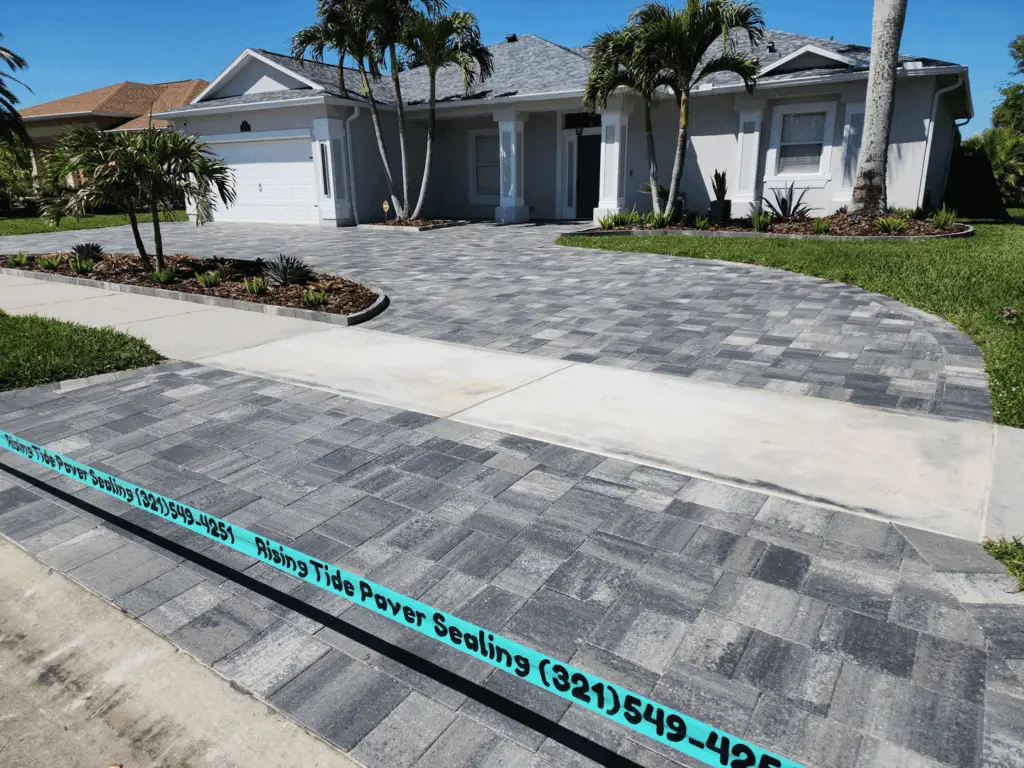
Paver sealing in Brevard County typically runs between $1.85 and $5.00 per square foot. Where your project lands in that range depends mostly on the size of the area, the condition of the pavers, and how much prep work they need before any sealer goes down. Below we walk through what moves a job up or down, so the number on your estimate makes sense.
The Short Answer: $1.85 to $5.00 per Square Foot
That range covers the surfaces we seal most: driveways, patios, walkways and pool decks. It is a per-square-foot price for the finished job, and our pricing includes the prep work: pressure cleaning, repairs and joint sanding. You should not be surprised later by a separate charge for cleaning.
The range is wide because no two paver jobs are alike. A newer patio that only needs a cleaning and a coat of sealer is a very different job from an older driveway with oil stains, empty joints and a peeling coat of sealer someone else put down.
A Quick Range Illustration
To see what the range means in real terms, here is the math for a 500-square-foot patio:
- At the low end: 500 sq ft × $1.85 per sq ft = $925
- At the high end: 500 sq ft × $5.00 per sq ft = $2,500
This is only the per-square-foot range applied to one size. It is not a quote, and it is not what a typical patio costs. Your actual price comes from measuring your area and looking at its condition in person, which is what the free estimate is for.
What Moves a Job Within the Range
Our estimates are based on three things: surface area, condition, and sealer type. Here is how each one plays out.
Size of the area. Square footage is the starting point for every estimate, so we measure first. A two-car driveway plus a front walk adds up faster than most people expect. Spaces that are tight or awkward to work around also take more time than an open, flat area.
Condition of the pavers. Clean, well-kept pavers need less work. Pavers with years of embedded dirt, mold, mildew, algae, oil or rust stains need more cleaning time before they are ready for sealer. Sunken spots and cracked or broken pavers get fixed before sealing, too, because sealer only protects what is underneath it.
Old sealer that has to come off. If your pavers were sealed before and that sealer is now peeling, flaking or turning white and hazy, it generally has to be removed before new sealer will bond properly. The Interlocking Concrete Pavement Institute (ICPI) also notes that some sealer types cannot be refreshed by simply recoating, and their removal is best handled by professionals. Paver stripping is a full extra step, so it pushes a job up. If you suspect your pavers need it, mention it when you call.
Joint sand. The sand between pavers keeps them locked together and makes it harder for weeds and ants to move in. It washes out over time, especially where runoff or wind hits the joints. Joints that are mostly empty take more sand and more labor than joints that just need a top-up. We cover this step in more detail in our post on paver sanding in Brevard County.
Sealer type and finish. Sealers are not all the same product, and ICPI notes some sealer chemistries cost more than others. You can choose a matte look or a glossy, wet look. Sun-faded pavers can sometimes be brought back closer to their original color with a tinted sealer, and pool decks need a sealer that can handle chlorine and constant water. Each of those choices affects the final number.
What Is Included in the Price
When we quote a paver sealing job, the price covers the full process, not just the sealer:
- Pressure cleaning to remove dirt, mold and organic growth
- Paver repairs where they are needed, so the surface is smooth and stable
- Joint sanding to refill the joints between pavers
- Sealer applied with professional equipment for even coverage
- A free, no-obligation estimate before any of it starts
Pavers that need more than a standard clean and seal, such as heavy staining, sunken areas or faded color, fall under paver restoration. We will tell you which one your pavers need at the estimate.
Why the Lowest Quote Is Not Always the Cheapest
Most sealing failures start with prep. ICPI says all dirt, oil stains and efflorescence must be removed before sealing, and that the pavers must be completely dry, with at least 24 hours without moisture or surface dampness, before most sealers go on. Skip those steps and the sealer can turn white or cloudy.
A cloudy or peeling sealer usually has to be stripped before the pavers can be sealed again, and that costs more than doing the job right the first time. We cover the most common failures in common paver sealing problems in Florida. Doing it yourself is an option too. Equipment and material costs vary, and the same prep rules apply.
How Long Your Investment Lasts
For most Brevard County homes, we recommend resealing every 2 to 3 years. ICPI says the right reapplication period depends on use, climate and the quality of the sealer, and our Space Coast mix of full sun, salt air and summer rain is hard on any coating. Our guide on how long paver sealant lasts goes into what shortens or stretches that window.
Keeping up with resealing also tends to keep later jobs simpler. Pavers that are cleaned and resealed on schedule usually need less prep than pavers left until the sealer has failed.
Rising Tide Paver Sealing is a veteran-owned company based in Palm Bay, serving Brevard County from Titusville down to Palm Bay and the beaches. For an exact number for your pavers, call (321) 549-4251 or request a free estimate.
Frequently Asked Questions
How much does it cost to seal pavers per square foot in Brevard County?
Paver sealing in Brevard County typically runs $1.85 to $5.00 per square foot. Where a job lands in that range depends on the size of the area, the condition of the pavers, how much prep they need, and the sealer and finish you choose. An in-person estimate is the only way to get an exact number.
How much does it cost to seal a 500 square foot patio?
At $1.85 to $5.00 per square foot, the range works out to $925 to $2,500 for 500 square feet. That is the range applied to one size, not a quote. The condition of the patio and the prep it needs decide where it actually falls.
Does the price include pressure washing and joint sand?
Yes. Rising Tide prices include the prep work: pressure cleaning, repairs and joint sanding. Removing an old, failed sealer is an extra step that only some jobs need, and it gets discussed during the estimate.
Why do paver sealing quotes vary so much?
Most of the difference is prep and materials. A quote that covers a thorough cleaning, joint sand and a sealer suited to the surface costs more than a quick rinse and spray. Skipped prep is also a common reason sealer turns cloudy or peels and has to be stripped later.
How often will I need to pay for paver sealing?
For most Brevard County homes, we recommend resealing every 2 to 3 years. Full sun, salt air, pool chemicals and heavy traffic wear sealer faster, so busy or exposed areas tend toward the shorter end of that window.